Why Brand Kits Are the Missing Layer in Most AI Content Workflows
AI tools made content faster, but for many teams the brand started sounding flatter. The missing layer isn't a better prompt — it's a Brand Kit that gives every draft a stable voice to start from.
· 7 min read
Most teams discover AI writing tools before they discover brand systems.
At first, this feels like progress. Content gets faster to produce. Captions appear instantly. Drafts that once took half an hour now take seconds. But after a few weeks, something subtle starts to go wrong. The posts are technically correct, yet they no longer feel recognisable. The voice shifts from platform to platform. Messaging becomes flatter. And over time, the brand starts sounding less like itself and more like the average version of everyone else.
This isn't a failure of AI. It's the result of skipping the layer that gives AI context in the first place.
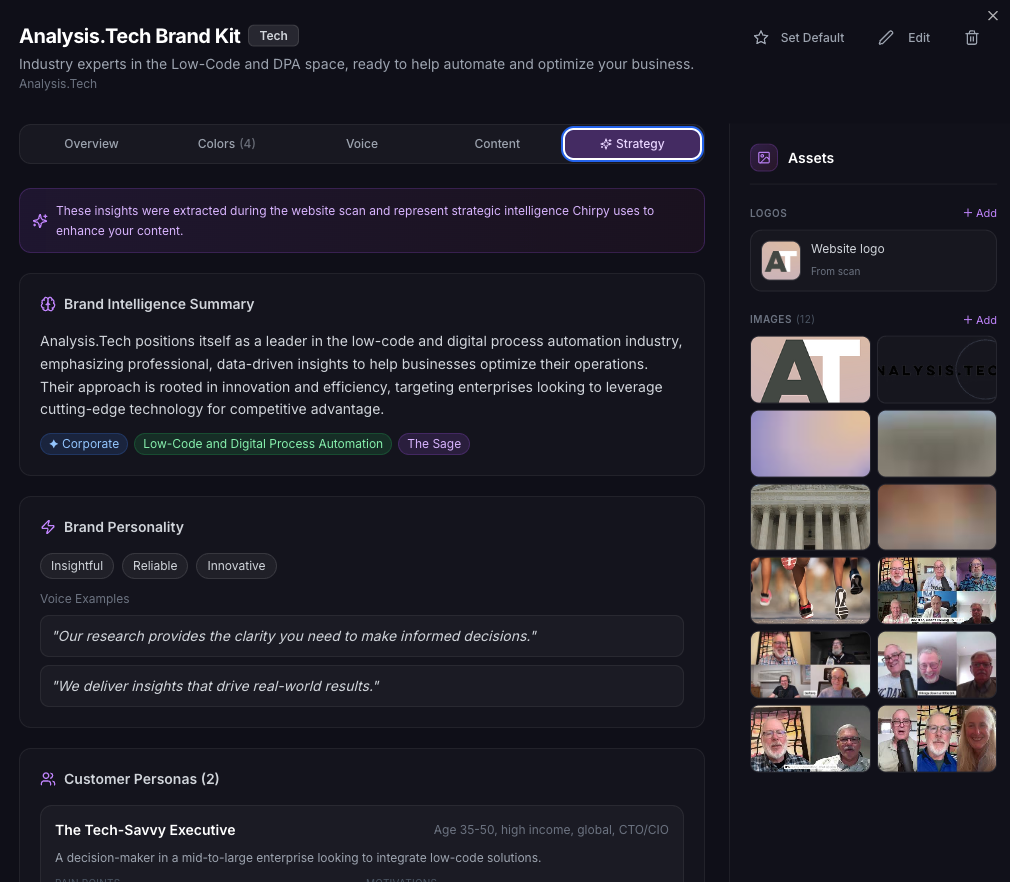
A Brand Kit is not just a place to store colours and fonts. In a modern content workflow, it is the structure that allows automation to remain consistent without becoming generic.
Why fast content often becomes weak content
When teams begin using AI tools for social media, the first improvement they notice is speed. What they do not immediately notice is the slow erosion of identity that happens when every new piece of content starts from an empty context window.
Without a persistent definition of tone, positioning, audience expectations, and messaging boundaries, each prompt becomes a negotiation. The system produces something reasonable, but rarely something distinctive. Over time, posts begin to resemble templates rather than expressions of a business that has a point of view.
This is why many companies feel that AI helps them publish more while simultaneously making their brand feel less clear.
The issue is not the writing quality. The issue is the absence of a reference framework that anchors the writing to something stable.
What a Brand Kit actually does inside a content workflow
A proper Brand Kit changes how content gets generated long before the first caption appears on screen. Instead of asking the system to invent tone repeatedly, it provides a persistent description of how the business communicates and what it wants to be known for.
That includes practical signals such as audience type and preferred level of formality, but it also includes strategic signals such as what topics the brand should lead with, what it should avoid sounding like, and what kind of outcomes its content should create for readers.
Once these elements exist in one place, every new draft begins closer to the final version. Editing becomes lighter. Consistency improves without additional effort. And teams stop rewriting the same adjustments across multiple platforms.
The difference is subtle at first, but it compounds quickly.
Why most AI content feels replaceable
One of the easiest ways to recognise whether a workflow is missing a Brand Kit is to ask a simple question: if someone removed the company name from your posts, would readers still recognise who wrote them?
For many businesses, the honest answer is no.
That happens because generic prompts produce generic structure. Even when the information is useful, it rarely reflects the personality of the organisation behind it. The language becomes interchangeable, and interchangeable language rarely builds long-term visibility.
A Brand Kit changes this by giving the system a memory of what the brand sounds like across time rather than across a single session.
Instead of generating isolated posts, the workflow begins generating recognisable communication.
Why this matters more as content scales
The importance of a Brand Kit increases as soon as more than one person participates in content creation.
Founders often begin as the voice of their business without noticing it. Their tone feels natural because it reflects how they already speak about their work. But as soon as marketing becomes a shared responsibility between team members, agencies, or external collaborators, the voice begins to fragment unless something holds it together.
A Brand Kit becomes that reference point. It allows different contributors to produce content that still sounds aligned, even when they work independently. Instead of relying on instinct, the team relies on shared structure.
This reduces editing cycles and prevents the slow drift that makes brands feel inconsistent across platforms.
The hidden role Brand Kits play in AI-assisted repurposing
Repurposing is one of the most powerful advantages of modern content systems, but it only works properly when the original idea remains anchored to a stable voice.
Without that anchor, repurposed content quickly turns into variation without direction. A LinkedIn post becomes an Instagram caption that feels unrelated. A short-form script loses the tone of the original message. The connection between platforms weakens instead of strengthening.
When a Brand Kit sits underneath the workflow, repurposing behaves differently. The same idea can travel across formats while still sounding like it belongs to the same organisation. Instead of rewriting content repeatedly, teams reshape it while preserving its identity.
This is where consistency stops being manual work and becomes a property of the system itself.
Why Brand Kits are becoming essential for search visibility
Search engines and AI discovery systems are increasingly able to distinguish between content that repeats common advice and content that reflects a defined perspective. As a result, businesses that publish large volumes of generic guidance are finding it harder to stand out than they did only a few years ago.
A Brand Kit helps solve this by making sure every piece of content reinforces a recognisable narrative rather than existing as an isolated answer to a question. Over time, that narrative becomes part of how both readers and search systems understand what the brand represents.
Instead of producing disconnected posts about marketing topics, the business begins producing a coherent body of work.
That coherence is what turns activity into authority.
Why many teams build Brand Kits too late
It is common for companies to postpone building a Brand Kit because it sounds like something that belongs later in the growth process. Teams often assume they need a full strategy document before they can define their voice properly, so they continue publishing without one.
In practice, the opposite is true.
The earlier a Brand Kit exists, the faster content becomes easier to produce and easier to recognise. Even a simple description of tone, audience focus, and positioning removes a surprising amount of friction from daily publishing. Over time, the kit evolves naturally as the business becomes clearer about how it wants to communicate.
Instead of waiting for clarity before documenting voice, documenting voice creates clarity.
The real purpose of a Brand Kit in an AI workflow
A Brand Kit is not a branding exercise in the traditional sense. It is a context engine.
It allows automation to remain aligned with intention. It allows teams to collaborate without losing tone. And it allows ideas to move across platforms without losing their identity along the way.
Most importantly, it changes how content feels to the audience. Instead of sounding like something generated for visibility, it begins to sound like something written by a business that knows exactly what it wants to say.
That difference is small at the level of a single post, but significant across months of publishing.
And over time, it becomes one of the clearest signals that separates brands people recognise from brands people scroll past.